


The Muslim Quarter
The Muslim Quarter is the largest of the old city's neighborhoods. It's a confusing array of narrow alleys that are wonderful to wander in, get lost, and stumble upon surprising discoveries.
Despite it's name, the area also houses a large number of important Christian institutions. The Muslim quarter begins at the northern city wall, goes south to the northern and western walls of the Temple Mount, to Hashalshelet Street, where the Jewish Quarter begins. To the West, it runs to Beit Chabad Street, which runs between it and the Christian Quarter.
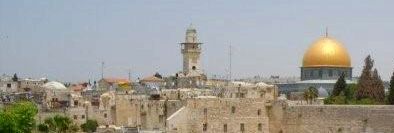
The area was first settled at the end of the Second Temple period and was included within the second city wall built by Herod the Great. Jews and a small early Arab population battled together to fight off the Crusaders, but at the end of the 12th century, the Crusaders evicted them and Syrian Christian Jacobites settled into the vacated homes.
Arabs moved back into the quarter after the conquest of Jerusalem by Saladdin in 1187. They were joined by Jews from Tsfat in the 1800's and in the late 1800's there were more Jews than Muslims living in the Muslim Quarter. The two populations coexisted peacefully until the Arab riots of 1929, when the Jews fled. Jews began returning to the quarter after 1967, and today the area houses several Jewish educational institutions.
The exciting, bustling shuk - market - is a focal point of the Muslim quarter. In fact, there are several such markets, although they blend together in a confusing maze of alleys. Some of these markets existed already in Crusader times, some in Roman times and perhaps much earlier than that. There is a spice market (a continuation of the Cardo, the commerical boulevard built by the Romans), a butcher's market, the Gold Market - which today sells mostly textile. Although many of the shops cater to tourists, the further in you venture, the more authentic your experience will be.
Here, you'll also find mosques, caranvanserai, travelers' hospices and bath houses that date from the Mameluk period (1267-1517).
The main attraction of the Muslim quarter is, of course, the Temple Mount.
There are several structures on the Temple Mount. The most famous is the Noble Sanctuary, better known as the Dome of the Rock. Contrary to popular misconception, the Dome of the Rock is not a mosque, but a shrine.
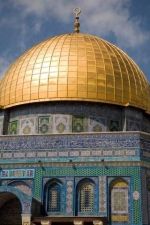
The al-Aqsa Mosque, at the southern end of the Temple Mount - the building with the grey dome - is Islam's third holiest site. It was build in the 8th century. It has been renovated many times. While it can hold up to 5,000 worshipers, there have been periods when the building was twice as large as it is now.
Visiting hours: Sat-Thu 8:30-11:30 and 13:30-15:00 in the summer; 7:30-10:30 and 12:30-13:00 in the winter. There is a fee for entrance to the Islamic Museum.
Closed on Fridays and Muslim holidays. Note also that Jewish religious law forbids Jews from ascending the Temple Mount.
If you cannot actually enter the Temple Mount, you can get a good view of the complex from the view point above the steps that come down from the Jewish Quarter to the Western Wall plaza.
The famed Via Dolorosa runs through the Muslim quarter, with Stations of the Cross 1 through 6 located in this quarter. The
Jerusalem mp3 Via Dolorosa tour
begins in the Muslim quarter and covers many of the major sites in this neighborhood.
In addition to the many Christian sites featured in the Via Dolorosa tour, you may want to pay special attention to the quarter's many Mameluk era buildings.
During the Mameluk period wealthy residents financed major construction projects as a way of avoiding the inheritance laws. This resulted in a veritable building spree in Jerusalem. Some of the notable examples of Mameluk architecture you may want to see include:
Return from The Muslim Quarter to the Old City: Experience the Holy City Jerusalem.
Return to Jerusalem Home page.

Traveler's Prayer
Our Gift to You!
Take us with you!
Only have a day or two in Jerusalem? Download our guidebook and make the most of your time here.
Introduction to Jerusalem: A Guide to the Holy City
"As we had limited time in Jerusalem, I purchased your mini guide book and found it very informative. Thanks!" - Brian, S. Africa
Top 5 Jerusalem Hotels
Click here for the top 5 discount hotels in Jerusalem.
Learn to Speak Hebrew:
Make Jerusalem part of your life:
Subscribe to our FREE newsletter.
Jerusalem Video
The 6-min virtual tour
New! Comments
Have your say about what you just read! Leave me a comment in the box below.